What the Latest YPCCC Climate Opinion Data Means for Climate Advocates
By Charlotte Ward, CCL Communications & Media Manager
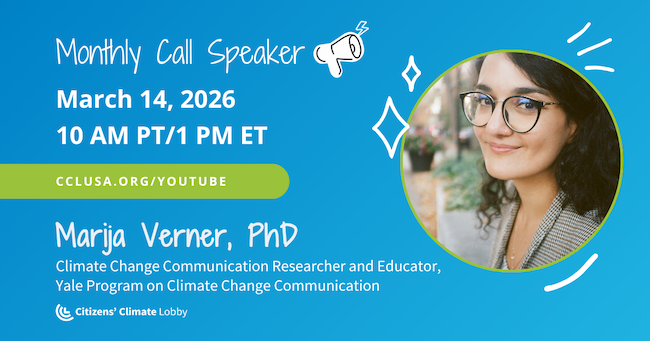
CCL’s March Monthly Meeting featured guest speaker Dr. Marija Verner from the Yale Program on Climate Change Communication (YPCCC). The good news she shared? You are likely talking to someone who already agrees with you on climate change.
During the call, Dr. Verner shared findings from the latest Climate Change in the American Mind, a nationally representative survey conducted twice a year by YPCCC in partnership with the Center for Climate Change Communication at George Mason University.
This ongoing research project surveys more than 1,000 Americans and produces two reports on Beliefs and Attitudes and Politics and Policy—providing one of the clearest pictures available of how Americans think about climate change.
Dr. Verner provided a summary of the latest data alongside key insights into how each stat impacts CCL’s work. The results?
Most Americans already agree
YPCCC’s latest data shows strong agreement across the country around climate:
- 72% of Americans think global warming is happening
- 64% are at least somewhat worried about global warming
- 77% of registered voters support U.S. participation in the Paris Climate Agreement
- 66% support more renewable energy
- 61% say clean energy should be a high priority for Congress and the President
Dr. Verner went on to unpack what these numbers mean for conversations around climate, saying “You are probably talking to someone who already agrees about the basics [of global warming] with you. The foundation is here, and the key is to figure out what to do about it and where to go from here.”
The perception gap
One of the most important findings from the survey is not just what people believe, but what they think others believe. While 64% of Americans say they are worried about climate change, 61% underestimate how many others are worried.
“We live with this phenomenon that we call pluralistic ignorance,” said Dr. Verner. “We don’t really gauge the public opinion or the actual worries of people around us that well.”
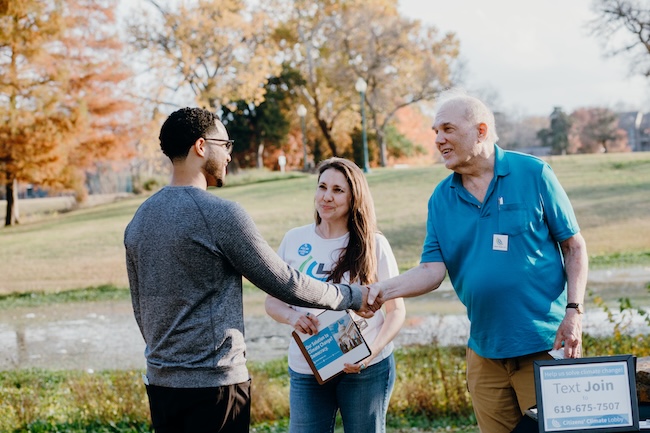
This misconception matters. When people think they are in the minority, they are less likely to speak up, even when they are actually part of the majority. Remember, when you open a conversation there are plenty of beliefs with robust support that can build a foundation for dialogue.
Political polarization
Digging deeper into the Politics and Policy report, Dr. Verner addressed the significant challenge of different political ideologies about clean energy:
- 92% of liberal Democrats agree clean energy should be a high priority
- 31% of conservative Republicans agree clean energy should be a high priority
“We can’t ignore political polarization,” she said. “It’s real. It’s an issue. Whenever we study factors predicting climate change, worry and concern, partisanship and political ideology are the strongest predictors of your views about global warming.”
How do we bridge that divide and overcome political polarization? Dr. Verner believes sharing personal experiences are key.
“One big thing YPCCC recommends is trying to connect global warming to people’s experiences as much as possible,” she shared. “Try to make it less abstract and less distant. Most people recognize that weather has been really weird for the past several years, so connecting that to climate change can be a strategy.”
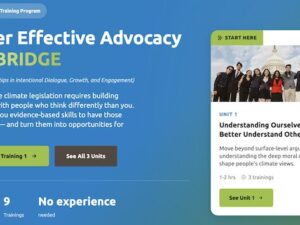
Second, Dr. Verner echoed key points from CCL’s BRIDGE training Unit 1 on Moral Foundations, emphasizing that we need to understand people come to the table on climate policy for different reasons.
“Democrats tend to support clean energy because they want to mitigate climate change,” said Dr. Verner. “Republicans who support [climate] policy tend to be motivated by economic costs and benefits.”
As BRIDGE teaches, moving beyond surface-level arguments and understanding the deep moral drivers that shape people’s climate views is key to constructive dialogue. The YPCCC team’s findings support this strategy to overcome polarization.

Bipartisan agreement
In even more positive news for CCLers, the YPCCC report showed bipartisan support for a policy area and bill we have advocated for—the Foreign Pollution Fee Act. The legislation would hold foreign polluters accountable for the climate impacts of goods exports to the U.S.
CCL views this policy as a critical step in ensuring that imported goods reflect their true carbon cost. The bill was reintroduced in Congress April 2025. In March 2025, 50 right-of-center CCLers lobbied 47 Republican offices on Capitol Hill to explain the benefits of foreign pollution fees.
While few respondents to the YPCCC survey had heard of a foreign pollution fee, support increased dramatically once it was explained. After a quick explanation, YPCC found:
- 69% of conservative Republicans supported the Foreign Pollution Fee Act
- 83% of moderates supported the Foreign Pollution Fee Act
- 87% of liberal Democrats supported the Foreign Pollution Fee Act
Dr. Verner noted that this support likely stems from both climate concerns and a sense of fairness—particularly around protecting American industry.
“Even if the name recognition is low, there is huge support when you explain it clearly,” said Dr. Verner. “Another takeaway from this is that it’s likely that some Americans are thinking about the fairness argument. They probably don’t feel it’s fair when countries have weaker environmental standards.”
CCL’s BRIDGE training shows that understanding why a constituent supports or opposes a certain policy helps shape constructive dialogue. It’s important to practice active listening and repeat certain points back to ensure you fully understand where the other person is coming from. From there, you can better shape your own response.
Climate concern still competes with other issues
Even with strong agreement, survey results showed climate change often ranks below other top issues like government corruption, the cost of living, and economic concerns. This tracks with most national data, and explains why it can seem like an uphill battle to push climate legislation forward.
However, on a positive note, this reinforces once again what we are exploring as part of our BRIDGE initiative: That climate conversations are most effective when they connect to the issues and moral concerns people already care about.
And if most Americans already agree on the basics, then the conversation doesn’t need to start with persuasion—it can start with solidarity. With the right knowledge and tools in our toolbox, we can effectively move the conversation forward, keeping climate change top of mind for constituents and lawmakers alike.
CCL’s BRIDGE training Units 1 and 2 are now available on CCL Community. Watch the recording of Dr. Marija Verner’s Monthly Meeting, then start your BRIDGE journey today.