Committed to repair: A conversation with Braver Angels’ Bill Doherty
By Miné Karatas
While divisive and partisan political rhetoric can be found just about everywhere, CCL is steadfast in the belief that listening well, connecting with values, and building durable relationships are all necessary to move forward.
Braver Angels is an organization that shares that perspective. Braver Angels is a citizen initiative—founded following the 2016 U.S. Presidential election—with the goal of bringing conservatives and liberals together to counteract political polarization and restore the fraying social fabric in American society.
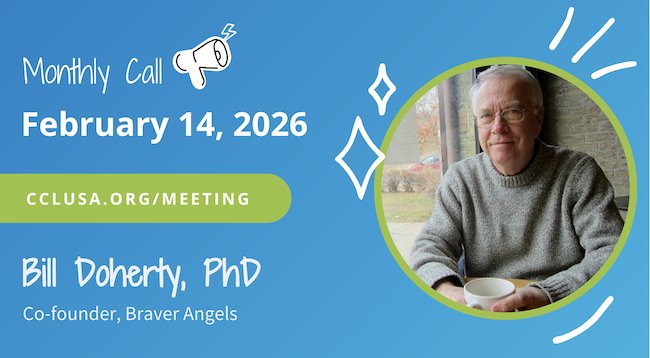
On our February 2026 national call, we were joined by Braver Angels’ Bill Doherty, an award-winning therapist and Professor Emeritus in the Department of Family Social Science at the University of Minnesota. He shared invaluable advice on navigating polarization.
The 3 Rs: Resist, Replace, Repair
In a public statement in January of this year, Bill shared that he thinks of social change as happening in three steps: Resist, Replace, and Repair. He expanded on these ideas in our meeting.
Resist: “This means protest,” said Bill. “Standing up against unjust leaders, institutions, laws, or structures that harm people.”
Replace: This is about developing new ideas, Bill explained. “If resistance succeeds, what comes next?”
Repair: “These are efforts to attend to the kind of ruptures in the social fabric that have been created through the process of social change and of dealing with polarization over how the country should move forward,” explained Bill.
Bill views all three Rs as necessary. But he cautioned that an organization has to decide where it’s going to focus. “It’s almost impossible for an individual organization to put resources and effort into Resist, Replace, and Repair at the same time,” he said.
“You guys [Citizens’ Climate Lobby] are in the Replace category first, and then bridge-building — which I would call Repair — second. If you engage in resistance against political figures or political parties, then what happens is you lose credibility in both Replace and Repair. You lose credibility in the policy area, and it’s almost impossible to work on Repair because you’ve taken sides.”
Respond, don’t react
It’s not always easy for an organization to maintain that commitment to Replace or Repair — in part because people can and do judge that approach. Bill acknowledged, “Sometimes people who are energized about resistance and protest can assume that anybody who’s working on Repair is sort of, you know, changing the chairs on the Titanic.”
But each of the Rs are important, and the choice to stay focused and disciplined on Replace or Repair comes from a place of responding, instead of reacting.
Bill explains, “Reacting just goes through your spinal cord. You touch something hot, and you pull back. Responding goes through the cerebral cortex. We process how we feel, but we also reflect on what the most effective response would be at this point. To respond to something, one must take the time to reflect on what is happening, process it, and then decide on how to approach it.”
This ability to respond, rather than react, “makes us strong individuals in the political realm,” Bill says, keeping our organization “focused on [our] goals and missions without being emotionally influenced by deflecting ideas.”
Stay hopeful
Bill emphasizes that, even amid challenges, it is important to hope. “For me, hope is a choice. It’s not always based on rational considerations,” he said. “The problems are grave, and I feel obligated to do something constructive and to not depend on seeing outcomes in the short term,” says Bill.
He encouraged people to stay in connection with others who feel the same way. Braver Angels chapters tune in every month to get an infusion of hope from national leaders who openly engage with one another. Being with others who are holding on to hope is a big antidote. It is a small but meaningful step in making progress.
Bill reminds all of us of the importance of a positive mindset, choosing to be patient, staying curious, and building connections to make long-term progress.
“An advantage to working on Repair and bridge-building is that you do see gains. You find common ground. This week in Minnesota was hard,” he acknowledged, referencing multiple recent instances of deadly violence from federal agents in the city. “But I did a workshop called ‘Depolarizing Ourselves,’ and it lifted my spirits because 35 people came to ask, ‘How do I look at my own inner polarizer and keep respect for the humanity of people I disagree with?’
Thank you to Bill for sharing his wisdom and perspective in our February meeting! Watch his full interview with CCL Communications and Media Manager Charlotte Ward here:
Interested in learning more about Braver Angels? Check out CCL’s Braver Angels Action Team.
Miné Karatas is a Communications Intern with CCL for Spring 2026.